> For the complete documentation index, see [llms.txt](https://help.adalo.com/llms.txt). Markdown versions of documentation pages are available by appending `.md` to page URLs; this page is available as [Markdown](https://help.adalo.com/feature-templates/user-profile-and-account-settings/setup-step-1-screen.md).
# Setup Step 1 Screen
Creating a user friendly way to onboard new users through a profile creation process is an important part of any app where user profiles can be accessed by multiple people.
Oftentimes when logging into a user-centric app for the first time, the first couple of steps are around creating a user profile. With this feature template the ‘Setup Step 1’ Screen guides users through the process of filling out user specific profile information.
## The Components
### **Header Group**
The Header Group is a visual way to let the users know where they are in the process of creating their user profile. If you are a user, you want to know how far you are in the process and what’s coming up next and this is a simple way to show that!
On each of the three set up screens, the icon color changes to denote which step in the process the user is currently at.
⚡ **Overview Actions**
* Link Action “Back” to the previous screen.
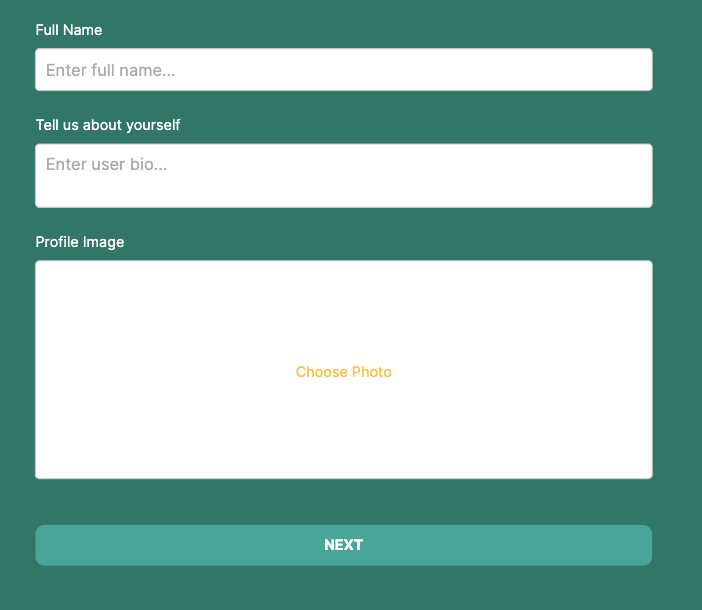
### Form Component
This component collects information about the user to fill in the properties within the User Collection.
There are more properties that can be displayed from the User Collection, however, this form collects information that has not been filled in during the sign up process — for example, a profile image and bio.
⚡ **Button Actions**
* Update User
* Link Action to ‘Setup Step 2’ Screen
---
# Agent Instructions
This documentation is published with GitBook. GitBook is the documentation platform designed so that both humans and AI agents can read, navigate, and reason over technical content effectively. Learn more at gitbook.com.
## Querying This Documentation
If you need additional information that is not directly available in this page, you can query the documentation by asking a question.
Perform an HTTP GET request on the following URL with the `ask` and `goal` query parameters:
```
GET https://help.adalo.com/feature-templates/user-profile-and-account-settings/setup-step-1-screen.md?ask=&goal=
```
`ask` is the immediate question: it should be specific, self-contained, and written in natural language.
`goal` is what the user is ultimately trying to achieve, the reason they need the answer. Sharing it helps GitBook give you a better, more relevant answer. A goal is most helpful when it describes the outcome the user wants rather than restating the question. For example, with `ask=how do I create an API token`, a goal like `automate deployments from our CI pipeline` lets GitBook tailor the answer to that use case.
The response will contain a direct answer to the question and relevant excerpts and sources from the documentation.
Use this mechanism when the answer is not explicitly present in the current page, you need clarification or additional context, or you want to retrieve related documentation sections.